
“Galileo’s Error: Foundations for a New Science of Consciousness” with Professor Philip Goff
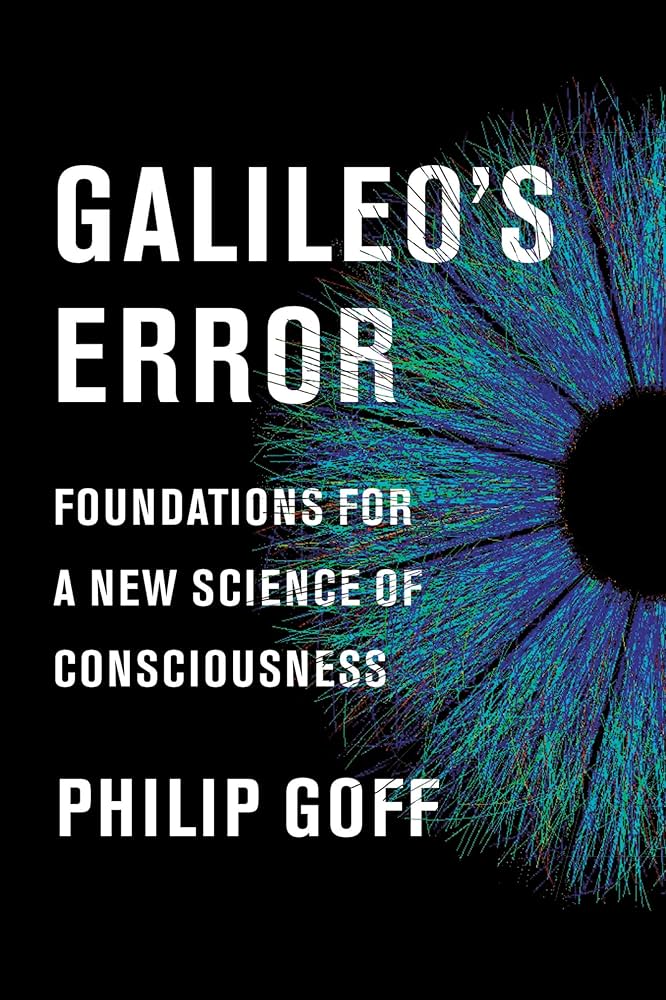
How does the brain produce consciousness? Why should electrical and chemical activity in the brain give rise to thoughts, emotions, colors, sounds, and the feeling of being alive? Despite major advances in neuroscience, the inner nature of experience remains difficult to explain. Modern science can describe the brain’s physical processes in great detail, but it still struggles to explain why those processes are accompanied by subjective awareness. The book “Galileo’s Error: Foundations for a New Science of Consciousness” by Professor Philip Goff takes this problem as its starting point. Goff argues that the difficulty may lie not simply in our lack of scientific knowledge, but in the way modern science has defined the physical world since Galileo. By separating matter from subjective experience, science became highly successful at explaining the measurable world, but left consciousness outside its basic picture of reality.

To address this, Goff introduces panpsychism: the idea that consciousness, in some very simple form, may be a fundamental feature of matter itself. The book aims to show why this view should be taken seriously and how it might offer a new path toward understanding the relationship between mind, matter, and the universe.

Philip Goff is a philosophy professor at Durham University, UK. He spends most of his time trying to work out the ultimate nature of reality. In this episode of Bridging the Gaps, I speak with Professor Philip Goff.

Our discussion begins with Philip Goff’s central claim in Galileo’s Error: that the scientific paradigm developed over the past five hundred years was designed, from the time of Galileo, to exclude consciousness from its picture of the physical world. We explore what this means, why Goff regards this exclusion as a mistake, and how it shaped the modern scientific worldview.

From there, the conversation examines how this Galilean paradigm differed from earlier ways of understanding nature, and how it contributed to a materialist view of consciousness: the idea that consciousness is simply an emergent product of physical processes in the brain. We consider what may be missing from this account and why it struggles to address the so-called “hard problem of consciousness”—the question of why and how physical processes give rise to subjective experience.

The discussion then turns to the contrast between the mathematical description of the world provided by science and the rich inner life of conscious beings. We consider Goff’s argument that science gives us an incomplete picture of reality because it describes matter from the outside while leaving out its intrinsic nature. This leads to the possibility that the hidden, intrinsic nature of matter may help explain human and animal consciousness.

A central part of the conversation focuses on panpsychism, the view that mind or consciousness is a fundamental feature of the world and may exist, in some basic form, throughout the universe. We explore what this means, whether it implies that the universe itself is conscious, and how this approach reframes the hard problem of consciousness. Finally, the discussion considers deeper questions about the fundamental nature of reality, including whether information may lie at its foundation, before concluding with reflections on the provocative title of the book, Galileo’s Error.

Complement this discussion by listening to From Consciousness to Synthetic Consciousness: From One Unknown to Another Unknown with David Chalmers followed by “The Case Against Reality” and The Hard Problem of Consciousness with Professor Donald Hoffman and Why You Are Not Your Brain? A Conversation on Consciousness with Alva Noe, Ph.D..
By |June 20th, 2026|Philosophy|

“From Sensing to Sentience: How Feeling Emerges from the Brain” with Professor Todd Feinberg

From Sensing to Sentience on Bridging the Gaps

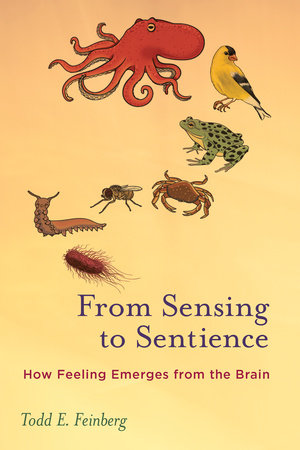
Sentience is the feeling aspect of consciousness, encompassing the capacity to experience sensations such as pain, pleasure, and emotions. It is the foundation of subjective experience, distinguishing beings that can feel from those that merely process information or react reflexively. Sentience is a crucial component of consciousness. A key question in studying sentience is how it emerges—whether it arises from complex neural processes, a particular form of computation, or something more fundamental. In his book “From Sensing to Sentience: How Feeling Emerges from the Brain”, Professor Todd Feinberg introduces “Neurobiological Emergentism (NBE)”, a theory explaining how sentience naturally arises as an emergent property of brain functions. Emergent properties are features of a system that do not exist in its individual parts but arise through their interactions. Integrating biological, neurobiological, evolutionary, and philosophical perspectives, Feinberg argues that sentience emerges as a “system-level property” of complex neural interactions. In this episode of Bridging the Gaps, I speak with Professor Todd Feinbergy.

Dr. Todd Feinberg is a board certified neurologist and psychiatrist and Clinical Professor of Psychiatry at the Icahn School Medicine at Mount Sinai in New York City.

We begin by exploring the basic sensory abilities of single-celled organisms, examining how they react to their environment and survive. We then trace the evolution of multicellular organisms, discussing that when they developed into more complex systems, there is a broader substrate for sensing. A key focus is how sensory abilities laid the foundation for the evolution of advanced neurobiological systems, ultimately leading to sentience. We discuss in detail how simple sensory functions in early life forms gradually evolved into the rich experiences of animals with complex nervous systems.

A central idea in the book is that “sentience emerges” as a property of complex neural systems. This perspective helps bridge the gap between neuroscience and philosophy, providing a natural explanation for how subjective experiences arise from the brain. We explore this argument in depth. Overall, this discussion provides valuable insights into the origins of sentience and its role in the evolution of consciousness.

Complement this discussion with “Sentience: The Invention of Consciousness” with Professor Nicholas Humphrey and then listen to “The Network of Life: A New View of Evolution” with Professor David Mindell

By |February 9th, 2025|Neuroscience, Podcasts, Research|

“Sentience: The Invention of Consciousness” with Professor Nicholas Humphrey

Sentience Book Reviewed on Bridging the Gaps

We experience, thus we exist. Our conscious perceptions form the foundation of our self-awareness. They play a vital role in shaping our understanding of ourselves as sentient beings: present, alive, and significant. However, what is the origin of consciousness, and how does the process of experiencing sensations and developing a sense of awareness contribute to its emergence? Is this capacity limited solely to humans? Do other animals share this ability? And what about the potential for future machines?

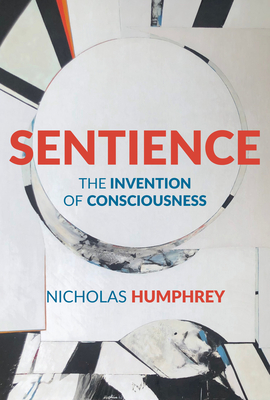
In his book “Sentience: The Invention of Consciousness” neuropsychologist Professor Nicholas Humphrey uncovers the evolutionary history of consciousness and argues that consciousness evolved to make us feel that life is worth living. Drawing upon his groundbreaking research on social intelligence, as well as his intriguing findings on blindsight in monkeys and profound insights into the philosophy of mind, Professor Humphrey outlines a fascinating narrative to unveil the evolutionary origins of consciousness. In this episode of Bridging the Gaps, I speak with Professor Nicholas Humphrey.

Nicholas Humphrey, Emeritus Professor of Psychology at the London School of Economics, is a theoretical psychologist, who studies the evolution of intelligence and consciousness. He was the first to demonstrate the existence of “blindsight” in monkeys. He has also studied mountain gorillas with Dian Fossey in Rwanda, and proposed the celebrated theory of the “social function of intellect,”. His research holds profound significance in exploring and unravelling the mysteries of the mind and its evolutionary underpinnings.

We start off by discussing the enigma surrounding the emergence of consciousness and the challenges encountered when attempting to understand its nature and origins. Professor Nicholas Humphrey’s book introduces the intriguing concepts of cognitive consciousness and phenomenal consciousness, which we thoroughly explore during our conversation. We then discuss in detail the concept of sentience as presented and explained in this book. We delve into the evolutionary perspective, examining why consciousness became an adaptive trait and how it evolved within living organisms. An intriguing question arises: if our early animal ancestors possessed cognitive consciousness, how did it transition into phenomenal consciousness? Could there exist an observable threshold, such as brain size, neuron count, or processing capacity, at which cognitive consciousness transforms into phenomenal consciousness? We then discuss the fascinating notion of blindsight and its relevance to the theory of consciousness presented in the book. We then delve into the complex concept of sensations, exploring how the firing of neurons and the movement of electric signals within the brain give rise to our subjective experience of consciousness. Lastly, we explore the possibility of consciousness emerging within machines, contemplating its potential evolution beyond organic life.

Complement this discussion with The Case Against Reality” and The Hard Problem of Consciousness with Professor Donald Hoffman and then listen to From Consciousness to Synthetic Consciousness: From One Unknown to Another Unknown with David Chalmers

By |July 15th, 2023|Artificial Intelligence, Neuroscience, Podcasts, Research|