
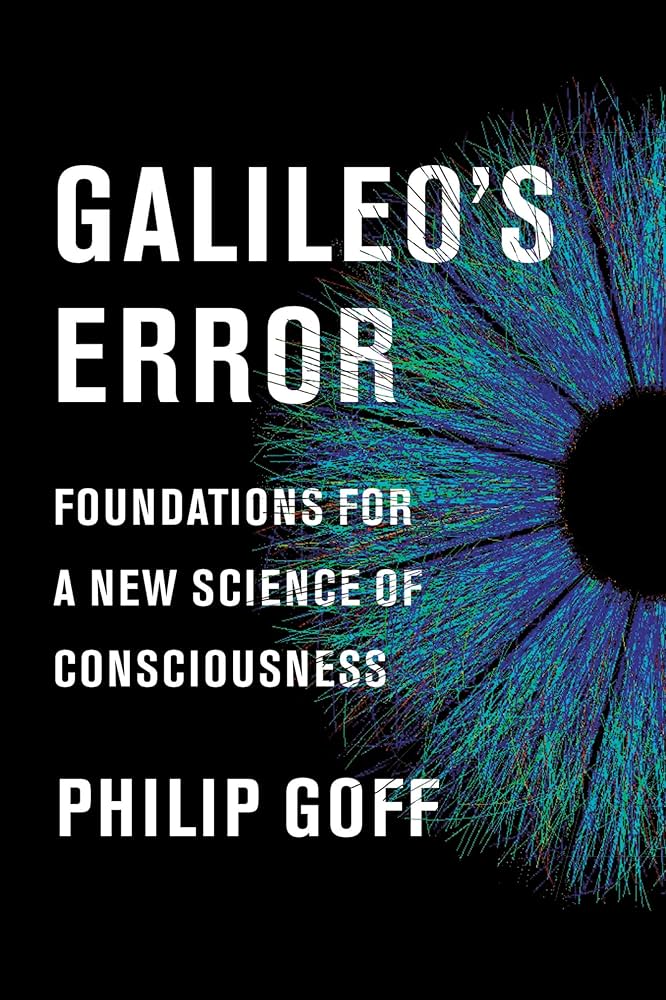
How does the brain produce consciousness? Why should electrical and chemical activity in the brain give rise to thoughts, emotions, colors, sounds, and the feeling of being alive? Despite major advances in neuroscience, the inner nature of experience remains difficult to explain. Modern science can describe the brain’s physical processes in great detail, but it still struggles to explain why those processes are accompanied by subjective awareness. The book “Galileo’s Error: Foundations for a New Science of Consciousness” by Professor Philip Goff takes this problem as its starting point. Goff argues that the difficulty may lie not simply in our lack of scientific knowledge, but in the way modern science has defined the physical world since Galileo. By separating matter from subjective experience, science became highly successful at explaining the measurable world, but left consciousness outside its basic picture of reality.
To address this, Goff introduces panpsychism: the idea that consciousness, in some very simple form, may be a fundamental feature of matter itself. The book aims to show why this view should be taken seriously and how it might offer a new path toward understanding the relationship between mind, matter, and the universe.
Philip Goff is a philosophy professor at Durham University, UK. He spends most of his time trying to work out the ultimate nature of reality. In this episode of Bridging the Gaps, I speak with Professor Philip Goff.
Our discussion begins with Philip Goff’s central claim in Galileo’s Error: that the scientific paradigm developed over the past five hundred years was designed, from the time of Galileo, to exclude consciousness from its picture of the physical world. We explore what this means, why Goff regards this exclusion as a mistake, and how it shaped the modern scientific worldview.
From there, the conversation examines how this Galilean paradigm differed from earlier ways of understanding nature, and how it contributed to a materialist view of consciousness: the idea that consciousness is simply an emergent product of physical processes in the brain. We consider what may be missing from this account and why it struggles to address the so-called “hard problem of consciousness”—the question of why and how physical processes give rise to subjective experience.
The discussion then turns to the contrast between the mathematical description of the world provided by science and the rich inner life of conscious beings. We consider Goff’s argument that science gives us an incomplete picture of reality because it describes matter from the outside while leaving out its intrinsic nature. This leads to the possibility that the hidden, intrinsic nature of matter may help explain human and animal consciousness.
A central part of the conversation focuses on panpsychism, the view that mind or consciousness is a fundamental feature of the world and may exist, in some basic form, throughout the universe. We explore what this means, whether it implies that the universe itself is conscious, and how this approach reframes the hard problem of consciousness. Finally, the discussion considers deeper questions about the fundamental nature of reality, including whether information may lie at its foundation, before concluding with reflections on the provocative title of the book, Galileo’s Error.
Complement this discussion by listening to From Consciousness to Synthetic Consciousness: From One Unknown to Another Unknown with David Chalmers followed by “The Case Against Reality” and The Hard Problem of Consciousness with Professor Donald Hoffman and Why You Are Not Your Brain? A Conversation on Consciousness with Alva Noe, Ph.D..

Connect With Us