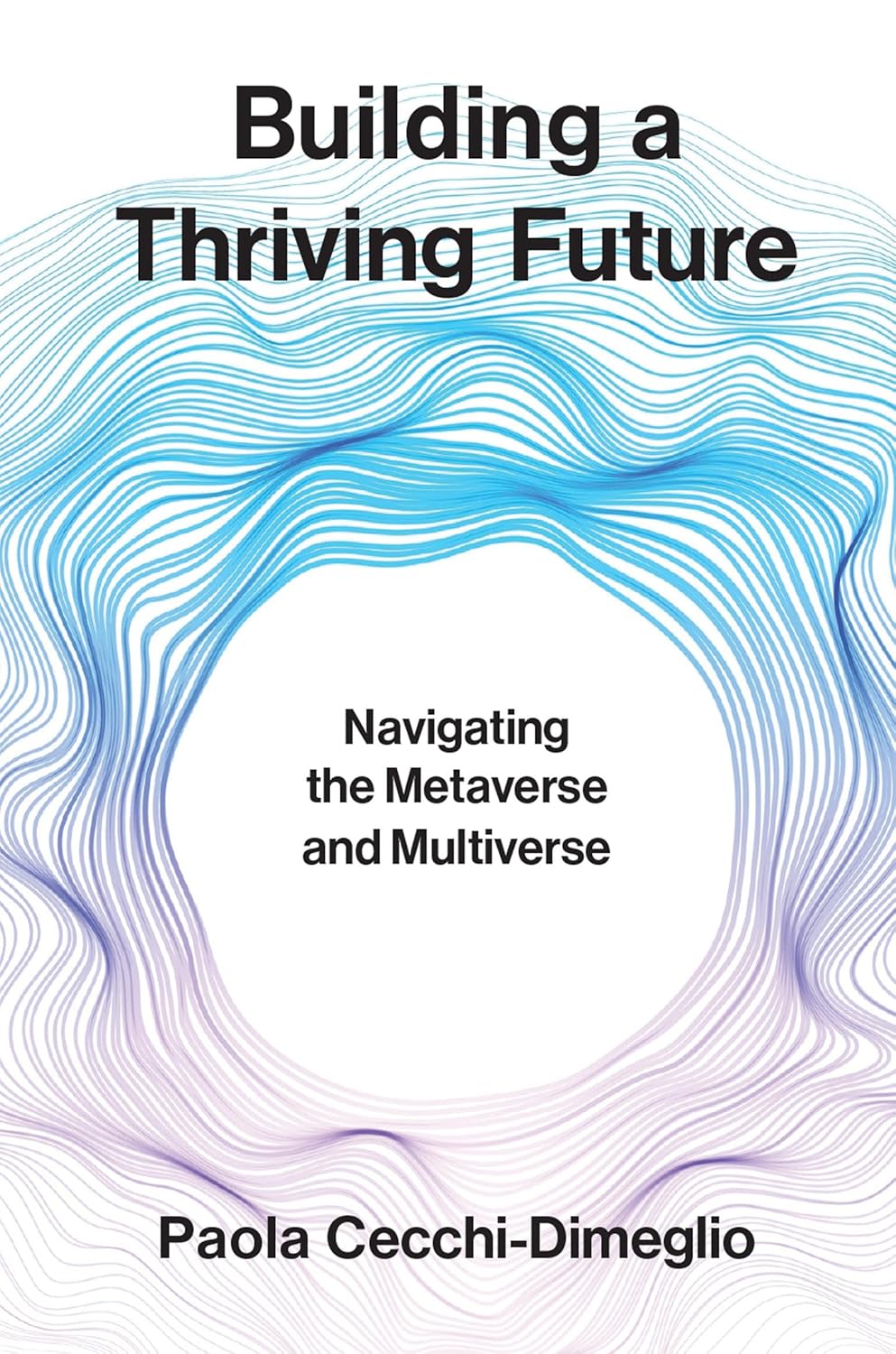
Building a Thriving Future: Navigating the Metaverse and Multiverse with Dr Paola Cecchi-Dimeglio

The metaverse is no longer a distant concept. It is unfolding now, driven by advances in artificial intelligence, big data, and immersive digital technologies. As it reshapes how we work, interact, and create value, it presents significant opportunities alongside growing competitive pressures. In the book “Building a Thriving Future: Navigating the Metaverse and Multiverse” Harvard researcher and AI strategist Dr. Paola Cecchi-Dimeglio provides the first strategy-focused guide designed for business leaders, policymakers, and decision-makers navigating this transformation. The book emphasizes that the metaverse is not simply about virtual environments. It represents a broader transformation of business, governance, and global markets. Organizations that combine AI, behavioral insights, and digital strategy will be the ones that define the future. In this episode of Bridging the Gaps I speak with Dr. Paola Cecchi-Dimeglio.

Dr Paola Cecchi-Dimeglio is an expert on AI and Big Data, Behavioral Science and Future of work. She holds dual appointments at Harvard Law School and the Kennedy School of Government, where she chairs the Executive Leadership Research Initiative for Women and Minority Attorneys (ELRIWMA). She is also a vice chair for the Global Initiative on Virtual Worlds and AI and leads Sustainability for AI, Big Data, and Metaverse regulation at the UN’s International Telecommunication Union. She is the CEO of People Culture Data Consulting Group.

We begin by acknowledging that virtual worlds are not a new concept. What is new, however, is the rapid advancement of hardware, big data, and AI, which is making the metaverse far more powerful and practical. We then examine why the metaverse should be understood as a critical development for business and organizational strategy. It is not just a technological trend, but a structural shift in how value is created and managed. We also explore how technologies such as blockchain can strengthen digital ownership and enable more secure, efficient trading within virtual environments. An important point we address is that, when developing business solutions for virtual worlds, organizations must give careful attention to diversity, inclusion, and equal access. Overall, the conversation offers a clear and insightful look at the strategic implications of the metaverse.

Complement this discussion with “From Pessimism to Promise: Lessons from the Global South on Designing Inclusive Tech” with Professor Payal Arora and then listen to “The Line: AI and the Future of Personhood” with Professor James Boyle.

By |February 17th, 2026|Computer Science, Future, Technology|

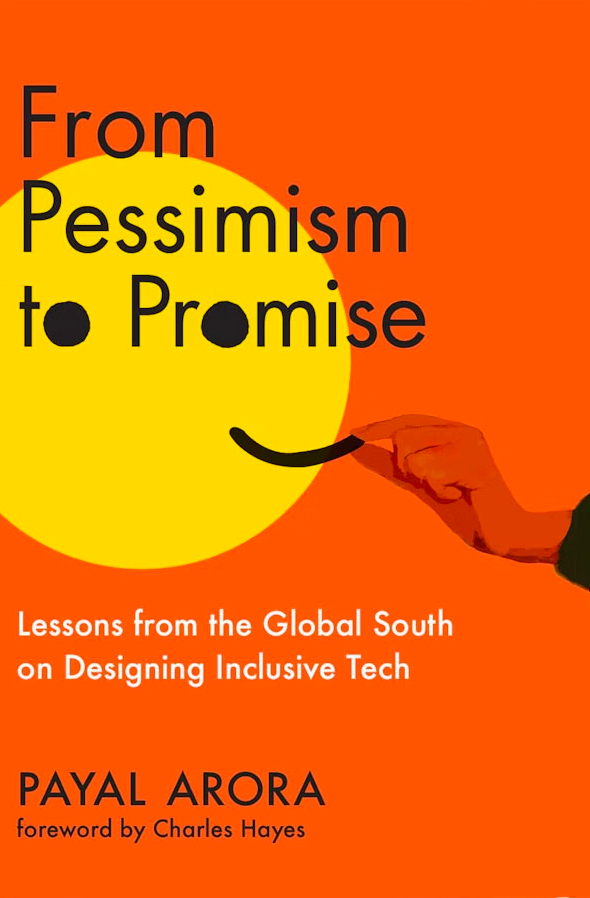
“From Pessimism to Promise: Lessons from the Global South on Designing Inclusive Tech” with Professor Payal Arora

From Pessimism to Promise on Bridging the Gaps A Portal for Curious Minds

The news about emerging technologies often sounds alarming as well as discouraging. Headlines talk about how algorithms control and oppress people. There are fears that AI could harm democracy, damage our social connections, or even cause human extinction. While these fears come from real concerns, it’s also important to recognize the good that technology offers. For young people, tech can provide a unique space for self-growth. In her book “From Pessimism to Promise: Lessons from the Global South on Designing Inclusive Tech”, award-winning author professor Payal Arora shares a different perspective, especially outside the Western world, where most young people live. In these places, there’s a wave of optimism about technology, especially among marginalized groups. These users see hope in the possibilities that new tech brings. In this episode of Bridging the Gaps, I speak with professor Payal Arora.

Payal Arora is a digital anthropologist, consultant, TEDx speaker, and the award-winning author. She is a Professor of Inclusive AI Cultures at Utrecht University and is the cofounder of FemLab, a feminist initiative focused on the future of work.

We begin by exploring how emerging technologies are transforming education in the Global South in positive ways. These changes are not just reshaping traditional systems but also offering new opportunities that bring hope to more people and foster greater inclusivity. Next, we emphasize the importance of context when evaluating and discussing these new technologies. A one-size-fits-all approach doesn’t work; instead, the impact of technology can vary greatly depending on cultural, social, and economic circumstances. Take the example of privacy—what privacy means and how it is valued can shift dramatically when considered in different contexts. In some communities, privacy concerns might revolve around data security, while in others, it may be more about social visibility or personal safety. This makes it essential to examine technologies through a local lens.

We also delve into the concept of the Global South, both as a geographical term and as a mindset. While the Global South refers to countries typically in Latin America, Africa, Asia, and parts of the Middle East, it is also much more than just a place on the map. It represents a way of thinking and living, shaped by shared histories of colonialism, economic challenges, and rapid adaptation to global forces. It is a concept rich with multiple contexts, where resilience and innovation are key themes.

Finally, we explore the sense of hope and optimism that emerging technologies bring to the Global South. In these regions, technology is often seen not as a threat but as a tool for empowerment. People are embracing digital advancements with excitement, seeing them as opportunities to overcome obstacles and build a better future. This contagious optimism is fueled by the ability to leapfrog over outdated systems, creating new paths for social progress, economic growth, and personal empowerment.

Complement this discussion with “Kendall Square and the Making of a Global Innovation Hub” with Robert Buderi And then listen to “The Good-Enough Life” with Dr Avram Alpert.

By |October 3rd, 2024|Future, Knowledge, Social Science, Technology|

“The Blind Spot: Why Science Cannot Ignore Human Experience” with Professor Adam Frank

The Blind Spot Reviewed on Bridging the Gaps

Since the Enlightenment, humanity has turned to science to answer profound questions about who we are, where we come from, and where we’re headed. However, we’ve become stuck in the belief that we can fully understand the universe by viewing it from a detached, external perspective. In focusing solely on external physical realities, imagined from this objective standpoint, we overlook the vital role of our own lived experience. This is the “Blind Spot” that astrophysicist Adam Frank, theoretical physicist Marcelo Gleiser, and philosopher Evan Thompson discuss in their book “The Blind Spot: Why Science Cannot Ignore Human Experience”. They identify this “Blind Spot” as the root of many modern scientific challenges —whether it’s in understanding time and the origin of the universe, quantum physics, the nature of life, artificial intelligence, consciousness, or Earth’s function as a planetary system. In this episode of Bridging the Gaps, I speak with astrophysicist Adam Frank.

Adam Frank is a renowned astrophysicist and professor in the Department of Physics and Astronomy at the University of Rochester. He is a leading expert on the final stages of stellar evolution, particularly for stars like the sun. At the University of Rochester, his computational research group has developed cutting-edge supercomputer tools to study the formation and death of stars. A passionate advocate for science, Frank describes himself as an “evangelist of science,” dedicated not only to uncovering the mysteries of the cosmos but also to sharing the beauty and power of science with the public. He is equally committed to exploring science’s broader role within culture, emphasising its relevance and context in our understanding of the world. His contributions to the field have earned him prestigious recognition, including the Carl Sagan Medal.

In this discussion we delve into why it is crucial to recognize this “Blind Spot” and the profound implications it has for how we approach science and knowledge. By focusing solely on external, objective facts, we miss a deeper understanding of reality—one that includes our subjective experience as an integral part of the equation. This Blind Spot has led to significant challenges in fields like quantum physics, cosmology, and the study of consciousness, where the limitations of purely objective observation become evident.

We also explore an alternative vision for science: that scientific knowledge should not be viewed as a fixed, immutable set of facts, but rather as a dynamic, evolving narrative. This narrative emerges from the constant interplay between the external world and our lived experience of it. In this view, science becomes a process of continuous self-correction, where both the observer and the observed are part of an evolving relationship. Frank stresses that recognizing this interplay allows us to break free from the illusion of absolute knowledge and opens up a more holistic, adaptive, and integrated way of understanding the universe. This shift in perspective has the potential to reshape how we approach not only scientific inquiry but also our relationship with reality itself. This has been an incredibly enlightening and deeply informative discussion, offering valuable insights and fresh perspective.

Complement this discussion with “The Joy of Science” with Professor Jim Al-Khalili and the listen to “Sharing Our Science: How to Write and Speak STEM” with Professor Brandon Brown

By |September 22nd, 2024|Future, Knowledge, Philosophy, Physics, Podcasts|