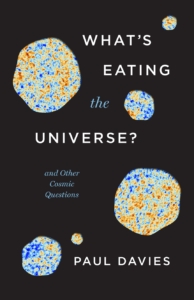
The universe is full of mysteries that scientists are still trying to understand. In the constellation of Eridanus, astronomers have discovered a strange region that looks like a giant hole in space. What caused it? This is just one of many fascinating questions about the universe. In “What’s Eating the Universe?”, famous cosmologist Paul Davies explores some of the biggest mysteries of space, including enormous black holes, disappearing regions of the universe, and the possibility of one universe swallowing another. He also explores two of the most important questions in science: Why does the universe exist, and how did lifeless particles eventually produce intelligent beings capable of thinking and questioning their existence? Through exciting discoveries and thought-provoking ideas, this book takes readers on a journey through space and time, encouraging curiosity about the universe, its origins, and the mysteries that remain unsolved. In this episode of Bridging the Gaps, I speak with Professor Paul Davies.
Paul Davies is a theoretical physicist, cosmologist, astrobiologist, broadcaster, and best-selling author. A winner of the prestigious Templeton Prize, he is Regents’ Professor of Physics and director of the Beyond Center for Fundamental Concepts in Science at Arizona State University.
Our conversation begins with a discussion about the structure of the book. Unlike his previous books, which explore specific topics through longer chapters, this book features short, accessible chapters, each addressing a fascinating question about the cosmos.
I then ask Paul about the intriguing title: What exactly is eating the universe? This leads us to explore the large-scale structure of the cosmos and the remarkable mathematical precision of its physical laws. We discuss whether mathematics is something humans invent or discover, and how mathematical principles help us understand the universe.
Next, we explore the nature of information and whether it might be a fundamental feature of reality. Our discussion then turns to the relationship between physics and biology. Can existing physical laws fully explain life, or do we need new physics? We also examine Paul’s view of life as a system that processes and replicates information, leading to one of science’s greatest mysteries: How did life begin?
We then consider the search for extraterrestrial intelligence and two possible outcomes: discovering that we are not alone or finding that life may be unique to Earth. I ask Paul which possibility he would find more troubling.
Towards the end, we explore some of the deepest questions raised in the book: Does the universe have meaning or purpose? How does consciousness emerge from physical processes? And will scientists ever develop a unified theory of everything?
Overall, this has been a fascinating and thought-provoking conversation, exploring the mysteries of the universe, the origins of life, and the fundamental nature of existence.
Complement this discussion with “Ten Patterns That Explain the Universe” and “Ten Days in Physics That Shook the World” with Brian Clegg and then listen to “Welcome to the Universe in 3D: A Visual Tour” with Neil deGrasse Tyson.


Connect With Us